
The Kindergarten year for Primary students provides them with the opportunity to bring their educational, social, and mentorship abilities to fruition. They begin to:
PRACTICAL LIFE & COMMUNITY
Not only are Practical Life exercises the foundation for learning in the Montessori environment, they are the cornerstone in a child’s development as a member of a community. The purpose of the Practical Life area is to help children develop coordination, concentration, independence, and a sense of order. The real-life activities also help develop the skills children will need for life as citizens of this world.
For students in their third year at our school, Practical Life exercises evolve into focusing on contributing and caring. Practical Life activities at this stage become more meaningful to the older children, as now, they complete them for the well-being of the community – from taking pride in caring for the plants and maintaining the beauty and cleanliness of the classroom to assisting and being role models for the younger children.
Through Practical Life exercises, the Extended-Day students are encouraged to use their independence as leaders and role models in the classroom. For example, the older students prepare snacks in the morning for the entire class. At lunch, they set the lunch tables. After lunch, they are in charge of cleaning up, which includes sweeping up crumbs and washing all of the dishes. Throughout the day, the Extended-Day students help younger students in the cloakroom by zipping up jackets and tying shoe laces. The younger students look up to the older students, giving the older students a sense of responsibility as they become self-reliant, strong, positive leaders.
All students in the Casa environment develop a sense of responsibility and self-confidence as they take care of the needs of the environment as well as the community. The third-year is extremely important as it is the year that everything the students have learned in previous years comes together. These experiences and feelings of self-confidence and responsibility are extremely valuable and irreplaceable.
LANGUAGE: Total Reading vs. Mechanical Reading
The key concept in Language for the child in the third, Extended-Day year of our program is Total Reading. This concept is based on the preparation of the mind and hand in the first and second years.
Dr Montessori introduced the concept of Total Reading as opposed to Mechanical Reading because she understood that true reading pertains to a complex mental activity and not merely to a verbal activity. For Dr. Montessori, language must be invested with meaning.
Mechanical Reading: To read mechanically is to simply sound out and link the various letters into words. Therefore, Mechanical Reading does not fully grasp the intention and emotions passed forth by the author.
Total Reading: Total reading is the perception of ideas through symbols where one is able to read in such a way so as to understand everything that the author wants to convey. Total Reading implies that the child experiences the completeness of understanding of what he reads, where he is able to relate to the author’s style and emotion. When mastered, it is a skill that lets one both gather information and fully relate to others.
There are various techniques used throughout our language program that lead to Total Reading. Some examples are:
It is our aspiration that through Total Reading, children will develop a love for literature and facile use of language in their everyday interactions.
MATHEMATICS
Math is a big concept for children to understand and is a process that cannot be rushed or forced. In our classroom, we aid the child’s process of abstraction of Math concepts by providing the child with many exercises that introduce different, individualized qualities. We do not teach children math when they first enter the classroom at age 3 because they must first develop their “Mathematical Mind”. The development of the Mathematical Mind unfolds in the first year. When the child has developed a certain level of clarity in their mind, the child will be ready to learn mathematical concepts. Attending Montessori for the full three years is very important for a child’s progression in math as the third year is the culmination of all of the indirect preparations and foundational math work done in the first two years.
There are four different qualities to look for to know the child is ready for math:
1. The child can establish patterns.
2. The child can establish relationships.
3. The child has an orderly mind.
4. The child can classify his or her surroundings.
There are three important qualities of the math materials in the classroom:
1. The child comes into physical contact with a concept that will become abstract, thus the child can first physically touch and manipulate a concept.
2. Only one concept at a time is presented to the child, always building on a previous concept that has been learned. We will not overwhelm or pressure children, so they develop a love of learning.
3. There are controls of errors within each material enabling the child to discern a mistake has been made.
There are six different areas of our math program:
1. Numbers from 0-10
2. The Decimal System
3. Counting numbers 1-1000
4. Exploration and memorization of the tables
5. Passage to Abstraction
6. Introduction to Fractions
Math is a journey that begins during a child’s first year in the Casa and truly comes together in the third year.
CULTURE
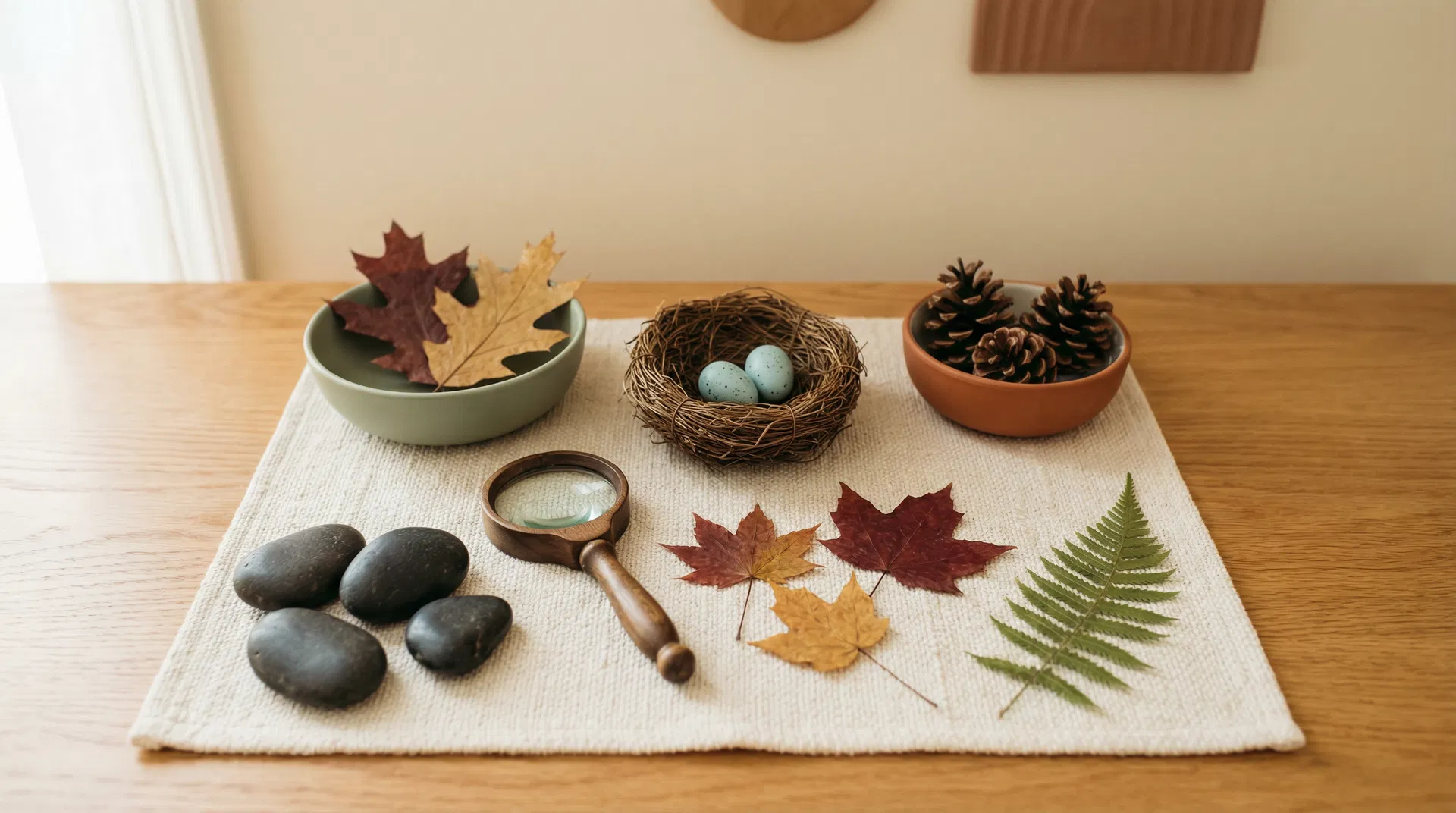
In the Montessori Primary program, we do not separate culture as a subject since the Practical Life, Sensorial, Language, and Math areas all inherently contain culture. It is a very significant area in the classroom that is present without being directly categorized. Cultural activities are found in art, music, writing of stories, geography, botany, zoology, and history.
Cultural activities require the integration of knowledge involving the hands, the senses, language (in a concrete context), and a mathematical mind (order, precision, and exactness), all of which are beyond the basics of the four areas of the classroom. The child’s work with culture is a continuation of the exploration of the materials surrounding them. When exploring cultural activities, we often encourage imagination with such materials as:
Through cultural activities, children learn different patterns in the world. They find answers to the questions of “how”. Children develop embellishment and humour. They uncover positive associations in different subjects. They practice calmness, which facilitates and maximizes independent learning and exploration. They learn to live with nature in an environment that is cultivating their love for learning. Ultimately, their learning experience truly becomes their own.
See Montessori in Action
The best way to understand authentic Montessori education is to experience it firsthand. Book a tour and visit our prepared environments.
BOOK A TOUR